
How Local Businesses Can Work Well With Schools (and Get Value From Every In-Kind Donation)
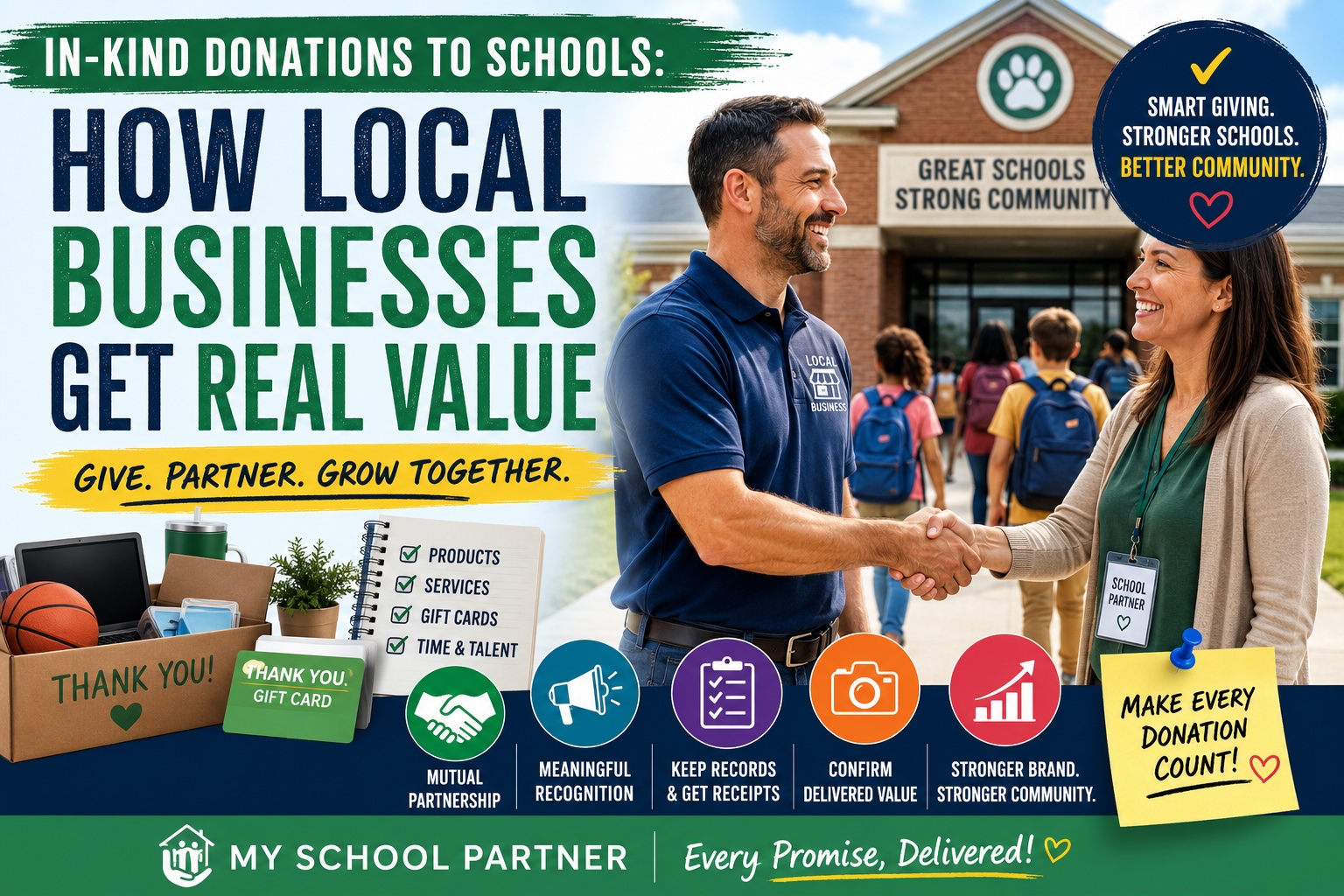
If you run a local business, you get the asks constantly. A gift card for the silent auction. Pizzas for teacher appreciation. A product bundle for the fall raffle. Printing for the flyers. Most owners say yes because they care about their community, and they should. But here's what I've learned advising hundreds of small businesses: giving to a school is a real investment, and like any investment, it works far better when you treat it with a little intention. This is a practical guide to working well with schools, including what to ask for in exchange for an in-kind donation, how to keep records, and how to make sure you actually get the value you gave.
Key takeaways
- An in-kind donation is a real marketing and community investment, so treat it like one.
- It's reasonable and expected to ask for recognition scaled to what you gave.
- Get the exchange in writing so both sides know what was agreed.
- Keep records and ask for proof that each promise was delivered.
- Save the school's written acknowledgment for your taxes.
Why working with local schools is good business
Let's start with why this is worth doing well. Supporting a nearby school isn't charity you do quietly and forget. It puts your name in front of the exact families who live and shop within a few miles of your door, and it builds the kind of goodwill you can't buy with a billboard. People genuinely prefer to do business with the companies that show up for their kids' schools. Done right, an in-kind donation to a school is community giving and smart hyperlocal marketing at the same time. The mistake is treating it as one and forgetting the other.
What an in-kind donation actually is
An in-kind donation is simply a gift of goods or services instead of cash. For a local business, that usually looks like product for a raffle or auction, gift cards, food for an event, printing or signage, professional services, or the use of your space. It counts every bit as much as writing a check, and here's the key point owners forget: it deserves the same recognition and the same records as a cash sponsorship. Too many businesses hand over three hundred dollars of product and ask for nothing, track nothing, and keep nothing. That's leaving the entire return on the table.
What to ask for in exchange for an in-kind donation
Asking for something in return isn't greedy. It's what turns a one-way handout into a real partnership, and any well-run school expects it. The rule of thumb is simple: ask for recognition scaled to the value of what you gave. A fifty-dollar gift card earns a thank-you and a social mention; a thousand dollars of product earns a banner and top billing. Here's a menu to pull from:
Reasonable things to ask for
- Your logo on the school or PTO website and in the newsletter
- Social media posts and a thank-you to their online community
- A banner or signage at the event you supported
- A booth, table, or moment to say hello at the event
- A mention in the program, announcements, or on a sponsor wall
- A written acknowledgment letter for your records and taxes
Notice the last one. Always ask for a written acknowledgment, every single time, even for a modest gift. It costs the school nothing and it protects you at tax time.
Get the exchange in writing
Once you and the school agree on what you're giving and what you'll get in return, put it in writing. It doesn't need to be a contract. A short email that lists the donation, its value, the date, and the recognition you were promised is plenty. This isn't about being formal or distrustful. It's about making sure that six months from now, both sides remember the same deal. In my experience, unclear expectations are the number-one reason a business ends up feeling like its generosity disappeared into a void.
Generosity you can't see is generosity you can't measure, and can't justify giving again.
Keep records, and confirm you got what you gave
This is the step almost every business skips, and it's the one that decides whether your giving is an investment or just an expense. When you donate to a school, keep a simple record of it: what you gave, its fair market value, the date, the school and your contact there, what you were promised in return, and whether each of those things actually happened.
Then confirm it. Ask the school to show you the recognition as it happens: a photo of your banner at the event, the link to the social post, a note that your logo went in the newsletter. Any organized school will gladly provide it, and this one habit turns a leap of faith into a documented, repeatable partnership. If you support more than one school, tracking all of it in one place matters even more, because it becomes impossible to hold in your head. This is exactly what My School Partner does for the business side: one place to see every school you support, proof of everything you were promised, and a year-end summary of your community giving for your marketing and your taxes. And when a school invites you, viewing and confirming your donation is free.
Valuing your donation for taxes
When the school organization is a registered 501(c)(3), a non-cash donation of product or services is often deductible at its fair market value, which is generally what you'd normally charge for it, not your cost. Keep documentation of what you gave and its value, and hold on to that written acknowledgment from the school. The rules around in-kind gifts have real nuances, especially for donated services, so please treat this as general information rather than tax advice and confirm the specifics with your accountant. Either way, good records make tax time painless and let you show, plainly, everything your business gave back this year.
Common mistakes businesses make
- Giving and asking for nothing. Recognition isn't rude to request. It's how the partnership works for both sides.
- Keeping no records. If you can't see what you gave and got, you can't judge whether to do it again.
- Never confirming delivery. The banner and the posts only count if they actually happened, and you can prove it.
- Skipping the acknowledgment letter. A thirty-second ask that saves you real money at tax time.
- Saying yes to everyone with no system. Support the schools closest to your customers, and track them all in one place.
The bottom line
Supporting your local schools is one of the best things a business can do, for your community and for your own growth. Just don't do it blind. Ask for recognition worth what you gave, get the deal in writing, keep clean records, and confirm that every promise landed. Do that, and an in-kind donation stops being money that vanishes and becomes one of the smartest local investments you'll make all year, one you'll be glad to make again.
Frequently asked questions
Are in-kind donations to schools tax-deductible for a business?
Often yes. If the school organization is a registered 501(c)(3), a non-cash donation of product or services is frequently deductible at fair market value, and you should get a written acknowledgment. The rules have nuances, so treat this as general information, not tax advice, and confirm with your accountant.
What can a business ask for in return for an in-kind donation?
Recognition scaled to the value you gave: a logo on the school or PTO website and newsletter, social posts, signage or a banner at events, a booth or table, a mention in the program, and a written acknowledgment for your records.
How do I record an in-kind donation to a school?
Keep a simple record of what you gave, its fair market value, the date, the school and contact, what you were promised in return, and proof that each item was delivered. Keep the school's written acknowledgment for taxes.
How do I confirm the school delivered what they promised?
Ask for proof of each item as it happens: a photo of your installed banner, links to the posts, confirmation of the event mention. Any organized school will happily provide it.
Make every donation count.
See every banner, post, and thank-you you were promised, with proof, across every school you support, plus a year-end report for your marketing and taxes.