
The Real Reason Schools Lose Good Sponsors (Hint: It's Not the Money)
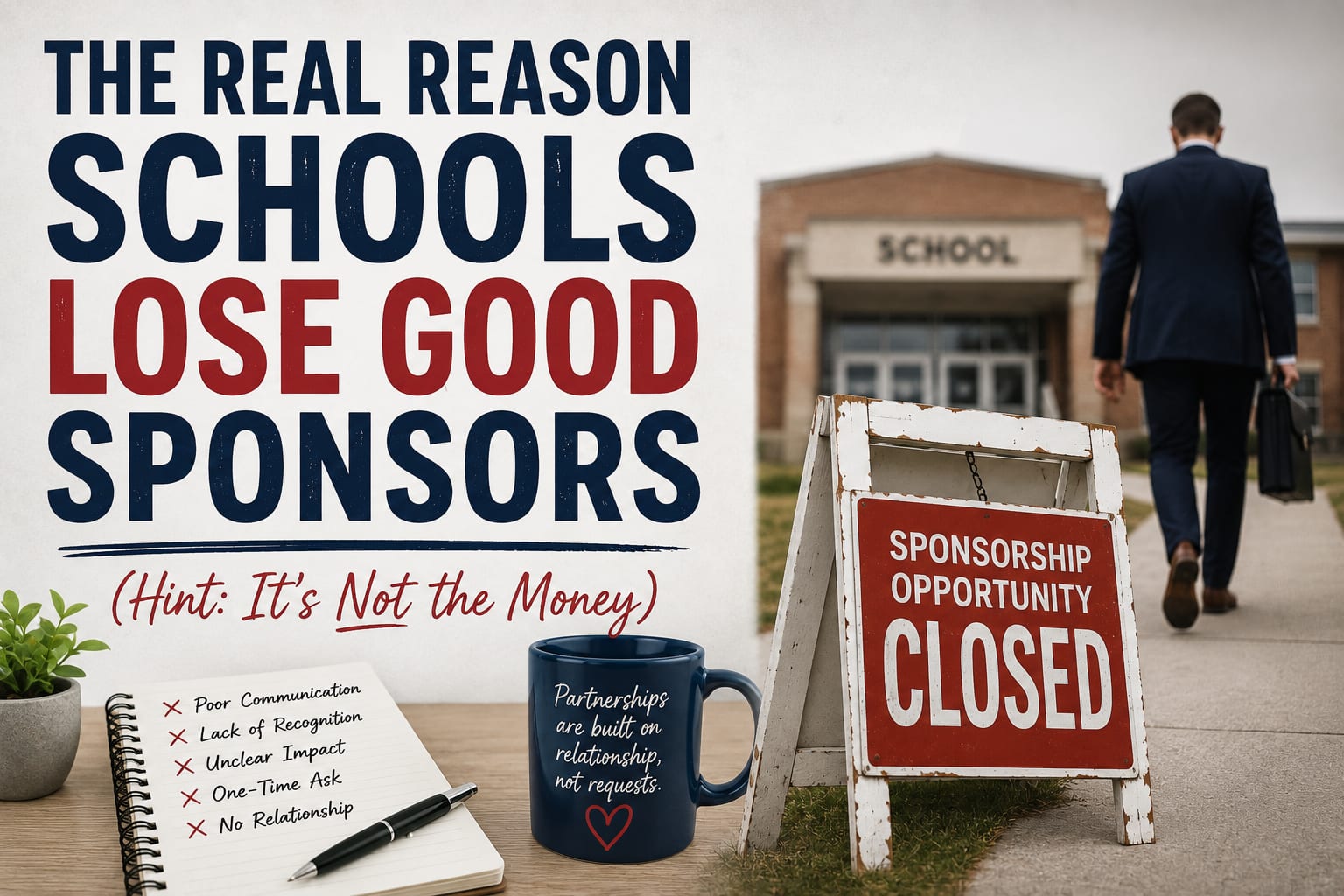
When a sponsor doesn't come back, the easy explanation is money — budgets got tight, priorities shifted, times are hard. It's a comfortable story, because it lets everyone off the hook. It's also, in our experience, usually wrong. Between the two of us we've spent years in the school cafeteria and the corporate boardroom, and the real reason schools lose good sponsors has almost nothing to do with the money.
The myth: sponsors leave because of budgets
It's true that budgets get cut. But here's what we've both learned from opposite sides of the table: businesses rarely cut the spending they can see working. They cut the spending they can't measure. When a business trims its budget, the first thing to go isn't the marketing that's clearly paying off — it's the line item nobody can point to and say, "here's exactly what we got for that." Far too often, a school sponsorship is that line item. So "we had to cut the budget" is frequently less a cause than a symptom: the sponsorship got cut because it had become invisible.
The real reason: they stopped feeling like partners
Good sponsors leave because, somewhere along the way, the relationship stopped feeling like a partnership and started feeling like a transaction. The check cleared, and then came silence. A banner didn't go up, or half the promised posts never ran — and nobody noticed. They never saw proof of the value they were promised. There was no real thank-you, no recognition. And when the board turned over, the new team treated them like a stranger to a school they'd supported for years.
Heather watched this happen for more than a decade of PTO and school-board service: businesses that genuinely loved the school drifting away, not because anyone stopped caring, but because the follow-through quietly fell apart. Mark has seen the mirror image while advising hundreds of small businesses: owners who wanted to keep giving, but couldn't justify a spend they had no way to see. Same story, two rooms.
"A partnership only lasts when both sides can see it working — and that's as true in a boardroom as it is in a cafeteria." — Mark Kaley, co-founder
Why this keeps happening (it's structural, not personal)
Here's the part worth sitting with: there's no villain in this story. The school isn't neglectful and the business isn't fickle. The problem is structural. The record of what was promised and what was delivered lives in a volunteer's spreadsheet, a few group texts, and a lot of memory — and every June, when the board changes, that memory walks out the door. There is no shared, lasting place where both sides can simply see the truth of the relationship. Without that, even the best intentions quietly erode into a lost sponsor.
The fix is visibility, not a bigger ask
If the problem isn't money, the solution isn't a slicker pitch or a higher price. It's visibility. A sponsorship survives when both sides can see it working: when every promise is tracked and delivered with proof, when the business can see the value it received, when the school recognizes the partner publicly, and when the relationship carries over intact no matter who's on the board next year. Make the partnership visible, and renewal stops being a sales job — it becomes the obvious next step.
That's the entire idea behind myschoolpartner: one shared record where the school checks off each promise with proof and the business confirms it. Not because software is magic, but because trust needs something to stand on — and a shared source of truth is that something.
What this means if you run a school
Stop treating sponsorships as something you re-sell from scratch every year, and start treating them as relationships you maintain. Deliver what you promised, prove it, recognize your partners, and never let a board transition erase what you've built. (We go deeper on this in how to keep your school sponsors year after year, and here's the school side of myschoolpartner.)
What this means if you're a business
Give your support the same scrutiny you'd give any marketing dollar: ask for the deliverables in writing, insist on proof, and keep track of what you actually received. You'll not only give more confidently — you'll be able to keep giving, because you can finally see it working. (More on that in is sponsoring a local school worth it, and here's the business side.)
The bottom line
Schools don't lose good sponsors because the money ran out. They lose them because the relationship became invisible. Fix the visibility, and you fix the retention — and a one-time check becomes a partnership that lasts. That's not a fundraising trick. It's just how partnerships work, in every room we've ever been in.
Frequently asked questions
Why do schools lose sponsors?
Usually not over money, but over the relationship: the business felt forgotten after the check cleared, promised deliverables went undone, they never saw proof of value, or a board turnover reset the relationship. It's a trust and follow-through problem — and it's fixable.
Isn't it usually about budgets?
Budget is the easy explanation, but businesses rarely cut spending they can see working — they cut spending they can't measure. A sponsorship a business can see delivering value survives a tight budget far better than one that felt invisible.
How do you keep a sponsor long-term?
Make the partnership visible: deliver every promise and prove it, show the sponsor the value they received, recognize them publicly, and keep the relationship intact when the board changes. When both sides can see it working, renewal takes care of itself.
Make the partnership visible.
myschoolpartner gives schools and their sponsors one shared record — every promise tracked, proven, and worth renewing.